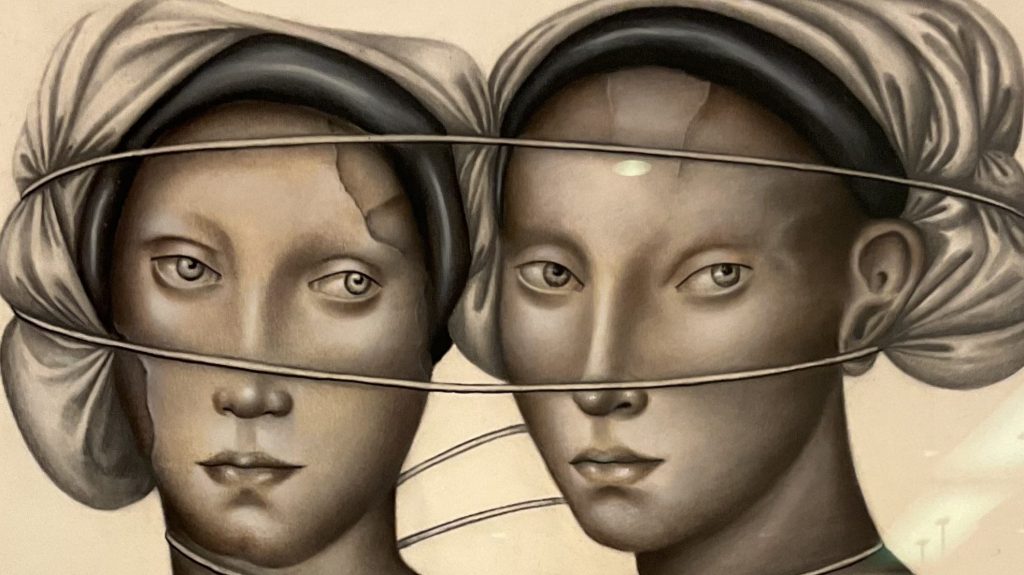
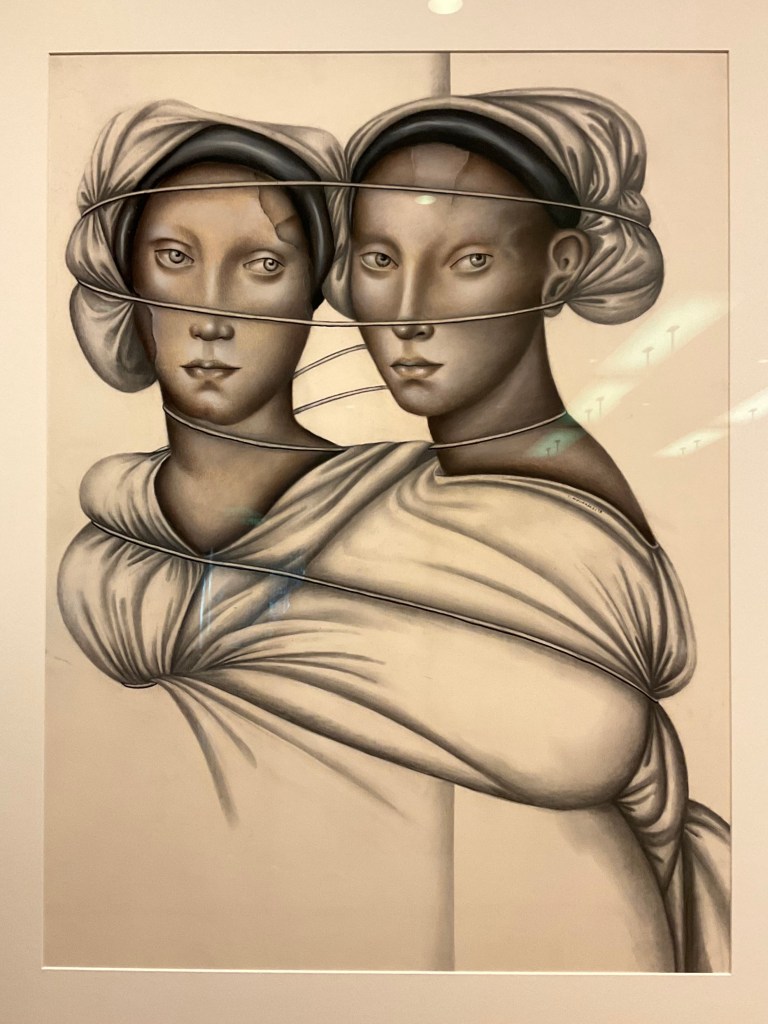
In instances of oppression, art has often served as a powerful tool of resistance and a platform for social commentary. This is particularly evident in the work of Chilean artist Carmen Aldunate, who created art throughout Augusto Pinochet’s regime that controlled Chile from 1973 to 1990. In her chalk and gouache drawing Untitled (1978), resistance takes shape through the intertwined forms of two women. They are placed closely to each other, with their heads touching. The women’s heads and bodies are covered by a plain white cloth that is wrapped with a cord, tightly pulling them together. The figures’ expressions are distant and cracks have begun to form on their idealized, smooth faces. The artistic approach is typical of Aldunate’s work, which often involves figures and symbolism depicted in an uncanny, almost Flemish style.
Technically, the piece is incredibly successful. The layering and blending of the different colors of chalk are seamless, creating subtle variations in light and shadow. Aldunate’s gouache linework is precise and sharp, carefully defining the cords that bind women and the drapery that surrounds them. The composition of Untitled creates a feeling of unity and balance between the two figures, with the only major disruption being a faint line that falls behind them vertically. Beyond the technical mastery, the symbolism within the piece is well-developed, especially when the piece is put into context. Aldunate’s work is one of many pieces of resistance made by Chilean women, for example, Arpilleras, or Chilean tapestries that served as an important form of expression for women living under the Pinochet regime. As I will demonstrate, the acquisition and exhibition history of the drawing at the University Art Museum at the University of Texas at Austin (now known as the Blanton Museum of Art) from the 1970s to today leaves questions as to how much interest actors at UT Austin, including collector Barbara Duncan, had in Aldunate’s political commentary.
Before the 1970s, Chile experienced a progressive democracy that was one of the longest-lasting in Latin America. Despite this, women in Latin America, Chile included, have historically been restricted by marianismo, a set of gender roles that coexist with machismo and expect women to be chaste, nurturing, self-sacrificing, and subservient. These expectations have been used to socialize women into normalizing patriarchal values and emphasize them as pillars of the family and the home. However, in 1973, the Pinochet regime overtook Chile and markedly changed the lives of women in the country. The highly conservative views of Pinochet’s administration placed women in a strictly motherly role that was enforced through legal reform and public policy. Until 1986, the Pinochet government upheld a Potestad Marital that handed women’s rights over themselves and their property to their husbands, stating that men owed their wives protection over themselves and their property in exchange for their wifes subservience. In addition to Potestad Marital, divorce was illegal and annulment was only available to women in higher social classes. Pinochet’s regime ended access to family planning programs, abortion, and contraception. Through propaganda and reform, Pinochet forced the role of motherhood and homemaker on women across the country.
Aldunate and her work were intensely molded by the women who came before her. In Carmen Aldunate: Sin Corazas, a book about the life of Aldunate, she lovingly describes her mother as a “hippie.” Aldunate’s maternal grandmother Adela was a conservative Catholic, but also a devoted feminist who fought for the rights of Chilean women. Her paternal Grandmother, Juana Ross, was among the wealthiest and most influential women of 20th century Chile. Known for giving back to underserved communities, Juana earned recognition as one of Chile’s greatest philanthropists. The artist specifically cites her grandmother Adela, who eventually became the subject of her first painting, as one of her greatest inspirations. In 1919, Adela founded the group Patriotic Action of Chilean Women, which promoted legal means to solve social issues such as women’s suffrage.
The influences of Pinochet and the women in Aldunate’s life who resisted his regime are evident in Untitled. The bound, distant figures in Untitled reflect the constricting social climate that Chilean women in 1978 experienced. The white cloth that covers the women’s heads and continues just below their necks mirrors the reality of a regime that controlled the way women dressed. The textile’s whiteness is symbolic of purity, a concept linked to marianismo and the womanly standards of Pinochet. Ropes tightly wind themselves around the figures, echoing the grip of policies and ingrained patriarchal ideals that impacted women under the regime, but also emphasizing closeness and unity between the women. They stare blankly into the distance, perhaps looking to an uncertain future, exhausted from the weight of domesticity, and feeling unsatisfied from a lack of opportunity. The figures float in space, ungrounded by reality, highlighting their distance from a life of agency. Cracks begin to form on their foreheads, a physical manifestation of a breakdown of the progressive societal role women had worked to achieve.
Untitled was obtained through Galería Epoca by collector Barbara Duncan in 1981 to fill a gap in the University of Texas collection of Latin American drawings, as they did not have enough works by Chilean artists. In other words, it appears in the case of this work, and others given by Duncan to UT in the 1980s, the leadership of the museum was setting collecting priorities. Eric McCready, then Director of the museum, was determined to obtain an Adulante piece from 1978, as recorded in documents contained in the Blanton Registrar Object File for the museum’s other work by the artist, Carmen Aldunate’s Retrato de un recuerdo (1981.39).
The drawing has been exhibited twice at UT Austin, with the difference between the two exhibitions revealing a shift in curatorial practices and perceptions of the piece’s political meaning. The piece appeared in Pop Crítico/Political Pop: Expressive Figuration in the Americas, organized by Vanessa K. Davidson and Carter Foster, in 2021 and the 1988 show Latin American Drawings from the Barbara Duncan Collection, curated by Jonathan Bober. In the 1988 collection show, Untitled was displayed by itself near the exhibition’s title wall, effectively depoliticizing the piece, and allowing it to stand alone without contextualizing its critique of the expectations put on women. In contrast, the curation of Pop Critico/Political Pop re-politicized the work by placing it alongside pieces that explicitly addressed the female experience, including depictions of motherhood and a portrait of a woman in office wear who holds her head in her hands. This juxtaposition guided viewers toward interpreting Untitled within the context of gender oppression and the struggles faced by Chilean women under Pinochet. Duncan’s decision to let the work stand alone may have been affected by her preference to exclude political leanings from exhibitions, as noted in correspondence with a colleague when discussing a separate exhibition. Conversely, politics were at the center of the Pop Critico/Political Pop show, which aimed to display the political voices of Pop artists.Carmen Aldunate’s Untitled stands as a testament to the resilience and defiance of Chilean women against the Pinochet regime. Through powerful symbolism, Aldunate’s piece represents the tight grip that women in Chile were living under in the 1970s and embodies the women who lived it. When diving deeper into Aldunate’s story, it becomes clear that she was born from a long line of strong women who were willing to fight for progress. Analyzing the history of the piece itself, the importance of contextualization becomes apparent when attempting to fully understand its message. This was demonstrated through Untitled’s exhibition history at the University of Texas at Austin. By contextualizing the work within its historical and artistic framework, we gain a deeper understanding of its message and relevance in the Chilean women’s fight against gender inequality. The imagery of Untitled continues to resonate today, in an era where the rights of women are being revoked once again. Aldunate’s Untitled transcends its artistic merit to become a powerful symbol of female resistance against the oppressive regime in Chile and elsewhere, while also serving as a reminder of the ongoing importance of art as a tool of resistance.
Clavel, Patricia Arancibia. Carmen Aldunate: Sin Corazas. Santiago: Editorial Catalonia, 2020.
International Women’s Rights Action Watch. “International Women’s Rights Action Watch Country Reports: Chile,” March 9, 1995. http://hrlibrary.umn.edu/iwraw/publications/countries/chile.htm#:~:text=Until%201986%2C%20the%20Pinochet%20government,in%20exchange%20for%20her%20obedience.
Kareithi, Megan Allen. “Women of Santiago: Gender Conceptions and Realities under Pinochet.” n.d.
Nuñez, Alicia, et al. “Machismo, Marianismo, and Negative Cognitive-Emotional Factors: Findings From the Hispanic Community Health Study/Study of Latinos Sociocultural Ancillary Study.” Journal of Latina/o Psychology 4, no. 4 (2016): 202–17. doi:10.1037/lat0000050.
Skidmore, Thomas E., and Peter H. Smith. Modern Latin America, 6th ed. New York: Oxford University Press, 2005.
Travis, Anna M. “Consolidating Power: Chilean Women in the Political Party System, 1950-1970.” Dissertation, Ohio State University, 2007.
 Soleil Parks
Leave a comment