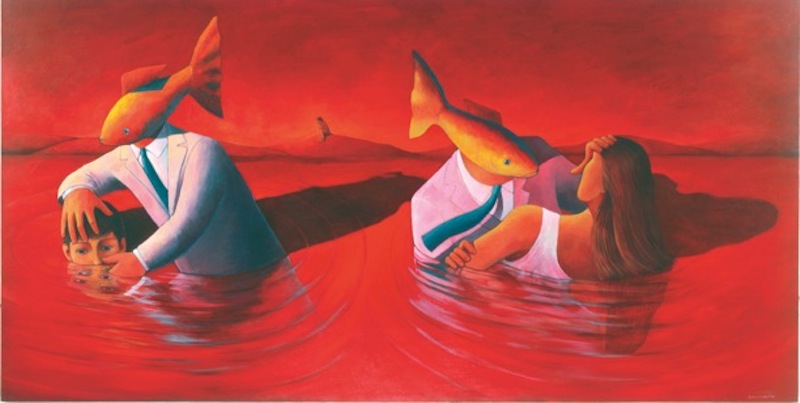
While working through the collections of notable artists and art historians at the Nettie Lee Benson Library’s archives, I came across a document that revealed an exciting connection: an exhibition program from Liliana Wilson’s 2002 show at the Esperanza Peace and Justice Center in San Antonio, Texas, featuring an artistic analysis by the renowned writer Gloria Anzaldúa. Titled Bearing Witness: Their Eyes Anticipate the Healing, Anzaldúa’s words offer a deep dive into paintings in the show, shedding light on powerful themes utilized by Wilson such as identity, memory, and dreamlike states of consciousness. The text also serves to show the ideas that Anzaldúa and Wilson shared around immigration, borderlands, and the psychological and emotional experiences of a life influenced by cultural hybridity.
The Bearing Witness exhibition program is one of many important Latinx documents housed at the world renowned Benson archive, including a collection of Anzaldúa’s papers. As I worked through the Liliana Wilson collection, which contains sketchbooks, publications, and personal materials such as letters, I was drawn to the exhibition program not only for its link to Anzaldúa, but also for the way it connected the ideas of two creative forces committed to exploring the complexities of cultural identity. Unfolding the pamphlet, I felt a sense of awe at the way Anzaldúa’s insightful commentary perfectly complemented the brilliance of Wilson’s visual works.
In Wilson’s show Bearing Witness, her dreamlike figures are often depicted alone, surrounded by blank voids with distant stares and expressionless faces. This imagery embodies a central theme in Wilson’s work: the tension between seeing and not seeing, between reality and dreams. Wilson’s ideas reflected in Anzaldúa’s commentary relating to the concept of “desconocimiento,” a state of being overwhelmed by reality and not wanting to confront it, which contrasts with “conocimiento,” the knowledge and awareness that comes from seeing and understanding. This tension between seeing and not seeing, between reality and dream, is a central theme in Wilson’s work. As stated in Wilson’s artist statement, it reflects the difference between the inner self, often in turmoil, and outer self, calm and collected.
This notion of merging the dream world with the physical realm connects the artist and writer, who both explore the blurring of realities boundaries, as well as complex impacts of cultural hybridity. Wilson is a Chilean immigrant who fled the country during the 1970s Pinochet regime, ending up in Texas. Her journey is directly addressed in the show’s painting Memories of Chile (2002), which depicts an androgynous figure in a nondescript space, blindfolded and surrounded by large, floating leaves. Because of this experience, Wilson was acutely familiar with the negative, distancing effects of cultural hybridity described in the writings of Anzaldúa.
In her most iconic piece of writing, Borderlands/La Frontera: The New Mestiza, Gloria Anzaldúa discusses, among other things, what she calls a borderland, or the unique space that exists at the border of two places. In her case, the United States and Mexico. To Anzaldúa, the border is neither fully Mexican nor American. The borderlands exist as a separate country, culture, and people. She classifies Wilson’s art as El arte fronterizo, dealing with “shifting identities, border crossings, and hybrid imagery” and breaking the restraints of mainstream restrictions on identity and cultural expression. Anzaldúa’s reflections not only enhance understanding of Wilson’s art but also provide a literary lens through which the depth and significance of her paintings can be appreciated in the context of borderlands and cultural identity.
The program for Bearing Witness serves as a testament to the interconnected ideas that these women explored in their respective fields, as well as the profound creative expressions that come from borderlands. Although Liliana Wilson does not have the direct borderlands experience of Anzaldúa, her work demonstrates the fact that she understands the difficulties of being suspended between two worlds, encapsulating the tension that exists in a state of transition. Her art gives form to the internal landscapes of those who navigate multiple worlds, offering a visual representation of the dual consciousness that Anzaldúa describes in her writings. Anzaldúa’s analysis of Wilson’s work provides an interpretive framework that not only enhances appreciation of the art but also deepens understanding of the broader cultural and social issues at play. Her reflections on the blurred boundaries between dream and reality in Wilson’s paintings resonate with her own exploration of the borderlands as a site of both conflict and creativity. Through their art and writing, Wilson and Anzaldúa offer us a vision of the borderlands and liminal migrant spaces as places where new identities are forged and old ones preserved, where dreams and realities intersect, and where creation can be used to explore the full spectrum of the human experience.
Anzaldúa, Gloria. Bearing Witness: Their Eyes Anticipate the Healing. Esperanza Peace and Justice Center, 2002. Box 1, Folder 8, Liliana Wilson Papers, Nettie Lee Benson Library, University of Texas at Austin.
“Liliana Wilson.” Esperanza Peace and Justice Center. Accessed September 30, 2024. https://esperanzacenter.org/artists/liliana-wilson/.
Rubin, David S. “Liliana Wilson’s Gentle Activism.” San Antonio Report, October 7, 2016. https://sanantonioreport.org/liliana-wilsons-gentle-activism/.
Silva, Elda. “Liliana Wilson’s ‘delicate worlds of horror’,” San Antonio Express-News, 2015. Box 5, Folder 7, Liliana Wilson Papers, Nettie Lee Benson Library, University of Texas at Austin.
 Soleil Parks
Leave a comment