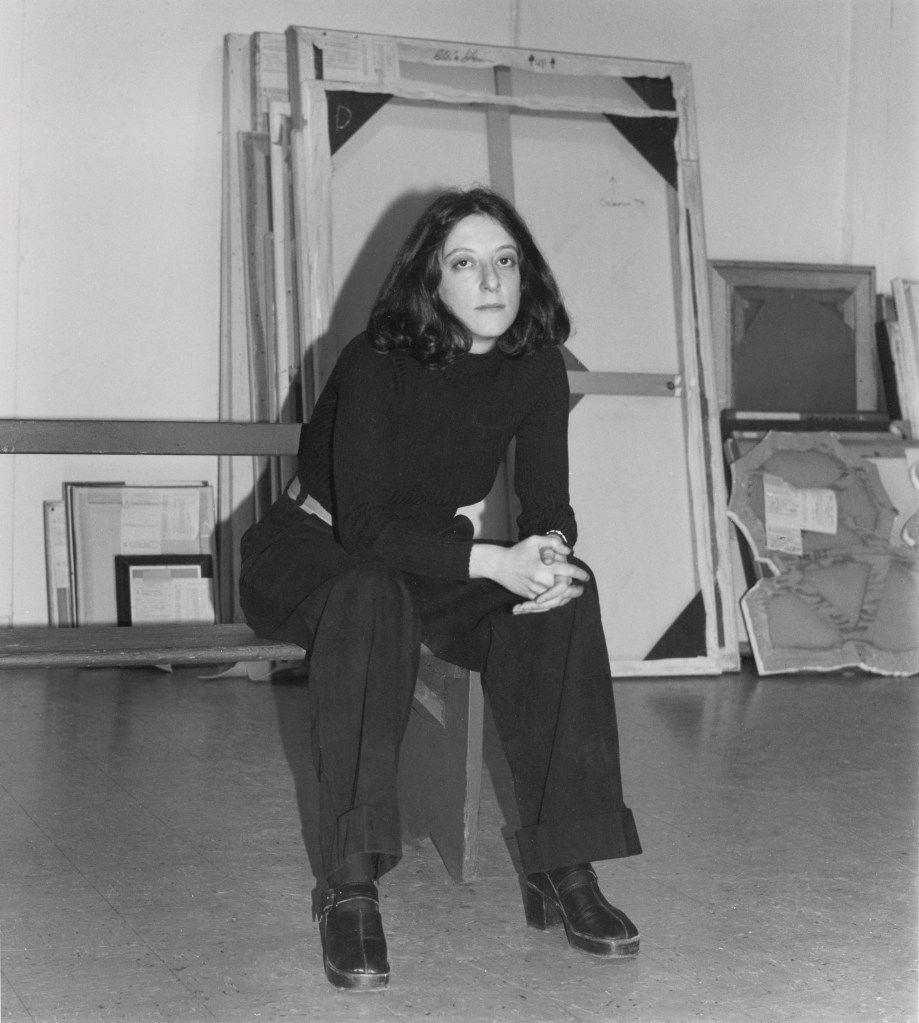
Marcia Tucker, c. 1973. Photo: Carlus Dyer, The New Museum
By analyzing an interview with the Archives of American Art, her memoir A Short Life of Trouble: Forty Years in the New York Art World, an exhibition catalog for the 1994 exhibition Bad Girls, and a collection of her professional writings titled Out of Bounds, this paper will explore the rhetoric used by museum director, curator, and art historian Marcia Tucker. Specifically, it will examine how she used rhetoric to define her professional identity, advocate for marginalized artists, and connect with museum audiences. The examination will also explain how Tucker’s curating itself functioned as a rhetorical act, shaping the dialogue around art, identity, and inclusivity. In addition to her time in museums, her upbringing and personal life will be examined to provide context for understanding the development and application of her rhetorical strategies. Tucker’s career was pivotal in shaping modern museum practices and broadening the American art world’s inclusivity. She was especially instrumental in introducing feminism and non-white artists into institutional dialogues and reimagining the structure of museums. Examining her rhetoric and practices highlights strategies women use in museums to advocate for systemic change and gain professional recognition during a transformative period in the art world.
Marcia Tucker was born in Brooklyn, New York in 1940 to a lawyer father and a stay-at-home mother. Tucker described her family as upper-middle-class but always striving for a higher status. There was no strong interest in the visual arts in her childhood home– save for a few Van Gogh reproductions– however, she and her father had a shared interest in theater and classical music. Her father prided himself on being an educated man and encouraged Tucker to read from his vast library of books (Tucker, Interview). Her father’s education and encouragement heavily influenced her. In her memoir, she describes a moment when he told her they would one day have their own practice, saying it made her feel like she could do anything she wanted (Tucker, Short Life 11). She also shared that he encouraged her to draw and write poetry (Tucker, Interview). Despite him encouraging her to be creative, Tucker’s father wanted her to be a lawyer, so he equally nurtured her intellectual side. However, ultimately, being intellectual in the Tucker household was compulsory and more damaging than nurturing. Tucker was forced by her parents to go to Connecticut College (far from her first choice), where she received a degree in painting. If she was not a perfect student with A’s across her report card her parents would refuse to speak to her, so she worked hard in school. She planned her escape by applying to a year abroad in France, where she intensely studied art history for a year. After falling in love with learning the secrets and backstories of the Louvre, she decided to work in museums (Tucker, Interview).
Based on what is known about her upbringing and her professional life, it is not far-fetched to assume that the latter was shaped by the former. By understanding the important role education played in her childhood, we can see the genesis of her sharp insights, compelling ideas, and brilliant writing that shows in a collection of her essays and lectures titled Out of Bounds. One lecture in particular, Women in Museums, given to the American Association of Museums in 1972, is especially relevant. She discusses the systematic exclusion of women in leadership roles and the undervaluing of female contributions in museums. The audience likely consisted of museum professionals, including directors, curators, educators, and administrators from institutions across the United States. Otherwise known as the individuals who were responsible for shaping museum policies, collections, and public engagement strategies. Given the era, the audience likely consisted mostly of white men who were not accustomed to women discussing these topics.
Tucker’s first sentence directly calls out the organization she is speaking for, “This is the first time in the history of the American Association of Museums that the issue of women in museums has been dealt with.” She goes on to discuss women’s historical role in museums, making up a large percentage of workers but mostly confined to being volunteers, secretaries, registrars, research assistants, cataloguers, and librarians (175). The domestic nature of museum work has been seen as an acceptable position for women, but Tucker says “The museum of today is no longer a genteel institution… Women who work in museums are also changing. We are no longer ladies of leisure, nor are we supported by independent incomes.” She tells her audience about the hiring practices they have unfairly subjected women to, such as asking what their husbands do and how much they earn and asking where and how they live. She explains the double-edged sword of female behavior in the workplace, either too emotional and sensitive or too pushy and tough (176). Then she goes into the dynamics in museum workplaces that patronize women, keep them from learning essential skills, stop them from receiving credit for their work, and make them feel like the odd one out. By discussing an experience where her male colleague of equal rank was routinely referred to as her “boss” at the Whitney Museum, she established undeniable credibility in speaking about systemic misogyny in museum workplaces (177).
To conclude her lecture, Tucker explained her ideas for fixing these issues. Firstly, she believed women must speak freely about the sexism they experience, regardless of the consequences they will face. Secondly, women working in museums must do everything they can to support female artists. Her third and final point is that men of power must hire without regard to race or gender, acknowledge their prejudices, and closely examine the role of women in their museums. Throughout the lecture, she boldly and bluntly addresses the men sitting in front of her, repeatedly using the pronoun “you:”
It is incumbent upon the men (and also the few women in positions of power) to … resolve, in every instance, to hire individuals according to their ability and potential–without regard to race or gender–and this does not always mean individuals with ‘proper training.’ That you examine your museums closely, and ask yourselves if there are women and blacks in top jobs. If not, why not? If so, are they, in every instance, given equal pay for equal jobs? If not, why not? That you acknowledge your own prejudice when and where it exists and attempt to change it. That you promote capable women, whether or not that position has ever been held by a woman before. (179)
Alongside the educational upbringing that gave her the confidence and skill to write incisive speeches, another factor that hugely affected Tucker’s development was her perceived difference from others. In Brooklyn, she grew up as the only Jewish child in a predominantly Italian-Catholic neighborhood. She and the one other Jewish student at her middle school were relentlessly bullied by their peers. She was also frequently ostracized by her mother, who was a tall, skinny, elegant woman. Tucker was short and squat, characteristics that her mother often criticized (Tucker, Short Life 6). In secondary school, she moved to an upper-class suburb in New Jersey and immediately felt like an outsider to the world of wealth and elite social dynamics she was dropped into. Here, she was a part of the “Ugly Club,” where weekly competitions were held to determine the ugliest member. Her feelings did not change when she went to college, where she described her fellow students as “rich and elegant” and herself as “a recluse.” (Tucker, Interview) During her college semester in France, she faced an unforgettable attack by anti-Semetic bargoers (Tucker, Short Life 23).
Tucker’s growing up in environments where she felt different later culminated in a sensitivity towards marginalized people. This empathy became a driving force in her career, leading her to champion artists and art movements that had been overlooked or dismissed by mainstream institutions. Her fight to represent what she believed in began at the Institute of Fine Arts at New York University, where she attended art history classes from 1962-1969 and earned her master’s degree (Tucker, Interview) (Smith). Here, Tucker was forced to go against the wishes of her thesis advisors to study the contemporary art that she found compelling. At the time, she described art critic Clement Greenberg as being the authority on what contemporary artworks were “good,” and therefore determined which pieces were studied in many American colleges. Unsurprisingly, Greenberg mostly focused on white, male artists. This was not of interest to Marcia Tucker, who wanted to study contemporary female artist Nancy Graves. A professor at the institute, Phil Rosen, described Graves’ work to Tucker as “Some girl who makes plastic camels.” Those camels later became the first show that Tucker organized at the Whitney (Tucker, Interview).
Tucker’s fight continued with her term as a curator for the Whitney Museum of American Art, beginning in 1969. This coincided with her joining the feminist movement, which was not a position received without resistance in her male-dominated workplace. Despite this, she allowed her feminist outlook to hugely affect the way she operated as a curator and the things she decided to communicate to the museum-going public. Although she describes the institutional climate as “already set,” she fought to do what she could from the inside (Tucker, Short Life 91). This included visiting women’s studios, recommending women for jobs, and training female interns. She also focused on women when curating exhibitions, and organized solo shows for over a dozen female artists. Additionally, Tucker used her position to uplift numerous artists of color, curating exhibitions for artists she regarded as extraordinary but believed had been overlooked due to systemic racism within the art world (Tucker, Short Life 92).
In addition to the important perspectives she forefronted at the museum, she also leveraged persuasive strategies to advocate for herself. When Tucker’s colleague Jim Monte told her that his salary was 20% more than hers in 1969, she immediately spoke up (Tucker, Short Life 96). In her memoir, she describes a meeting between herself and John Baur, the Whitney’s director, where she confronted him directly about several issues–including her pay. Although he originally responded with a sigh and a speech about “the budget,” Tucker pressed him by asking how he would feel if his daughters were in the same position. Two days later, she received a memo about her pay raise from the accounting department (98).
Despite working against institutional currents, Marcia Tucker significantly altered the Whitney Museum’s approach to exhibition programming by expanding its focus to encompass a broader, more inclusive representation of artists working across the United States. Tucker’s work demonstrated that curatorial decisions are inherently rhetorical acts, capable of reshaping public perceptions and challenging institutional norms. Before her tenure, the Whitney had a more conservative curatorial scope, often privileging well-established, predominantly white male artists who fit within a narrow interpretation of American art traditions. Tucker, however, saw the museum as an opportunity to challenge these conventions and amplify the voices of underrepresented artists, including women and artists of color. By deliberately showcasing artists who had been marginalized, her exhibitions conveyed an important message about the evolving role of museums as platforms for inclusivity and cultural dialogue. Her shows made her a pioneer in prompting museum visitors to reconsider their understanding of artistic merit and cultural relevance. This also allowed a wider range of her audience to see themselves represented in the museum.
In 1973, Tucker organized a show of Lee Krasner’s work, Lee Krasner: Large Paintings, for the Whitney, Krasner’s first major show in her native New York City (Cohen). At a time when Krasner was often only mentioned in addition to her husband, iconic Abstract Expressionist Jackson Pollock, Tucker’s foregrounding of her monumental abstract paintings emphasized Krasner’s individual artistry. The exhibition was significant not only for highlighting Krasner’s contributions as an artist but also because a female curator showing a female artist directly challenged the art world’s misogyny. Exhibitions like this one also fundamentally altered the experience of female museum visitors. In a space typically shaped by patriarchal narratives, a woman could finally see a show that featured the female experience in the paintings, catalogs, and wall texts.
After her time at the Whitney came to a close, Tucker felt tired of working within the confines of others’ ideas and was inspired to open her own museum. Her goal was to redefine the museum institution, to create a space of equality, growth, and new ideas. When she founded the New Museum in 1977, she made sure it lived up to its name. In the beginning, every staff member was paid the same salary of $12,000 and each person had an equal say in the way the museum ran and the exhibitions they organized (Tucker, Short Life 126).
One of her most iconic shows, and one of the last she organized at the New Museum, was Bad Girls in 1994. Bad Girls served as a culmination of Tucker’s engagement with feminism since the 1960s. It displayed works by women who “[defied] conventions and proprieties of traditional femininity” (Tucker, Bad Girls 4). Curating such a show late in her career served as a final affirmation of her professional identity as a curator unafraid to challenge institutional norms and embrace controversial themes. The exhibition reflected her alignment with feminist ideals and exemplified her ability to use her position to push boundaries. A humorous but direct challenge to the male-dominated art historical canon, Bad Girls celebrated irreverence, irony, and nonconformity. This approach embodied Tucker’s belief that art should provoke thought and dialogue rather than simply affirm established ideals. Her choice of artists and works created an accessible and relatable exhibition that resonated with diverse audiences, encouraging them to see art as a medium for personal and societal reflection.
In addition to Tucker’s showing of Krasner, Bad Girls demonstrates the ability of curation to function as a rhetorical device. Tucker’s texts written for the exhibition catalog address the curatorial decisions she made in the show and the message she intended to project. She begins the introductory text by stating that Bad Girls had its genesis in 1968 when the feminist movement hit New York. She explains that at the time, she was inspired by refreshing artistic takes on feminism that were funny, challenging, and daring enough to sometimes go a little “too far.” Unpacking her interpretation of a “bad girl,” she explores the nuanced history of the word “girl.” Once a term used by men to infantilize and belittle women far past girlhood, it evolved into an expression of solidarity and affection between them. Delving deeper into its connotations, she also mentions the roots of the term “bad girl” in African American Vernacular English (AAVE), where it referenced women “who challenge audiences to see women as they have been, as they are, and as they want to be” (Tucker, Bad Girls 4).
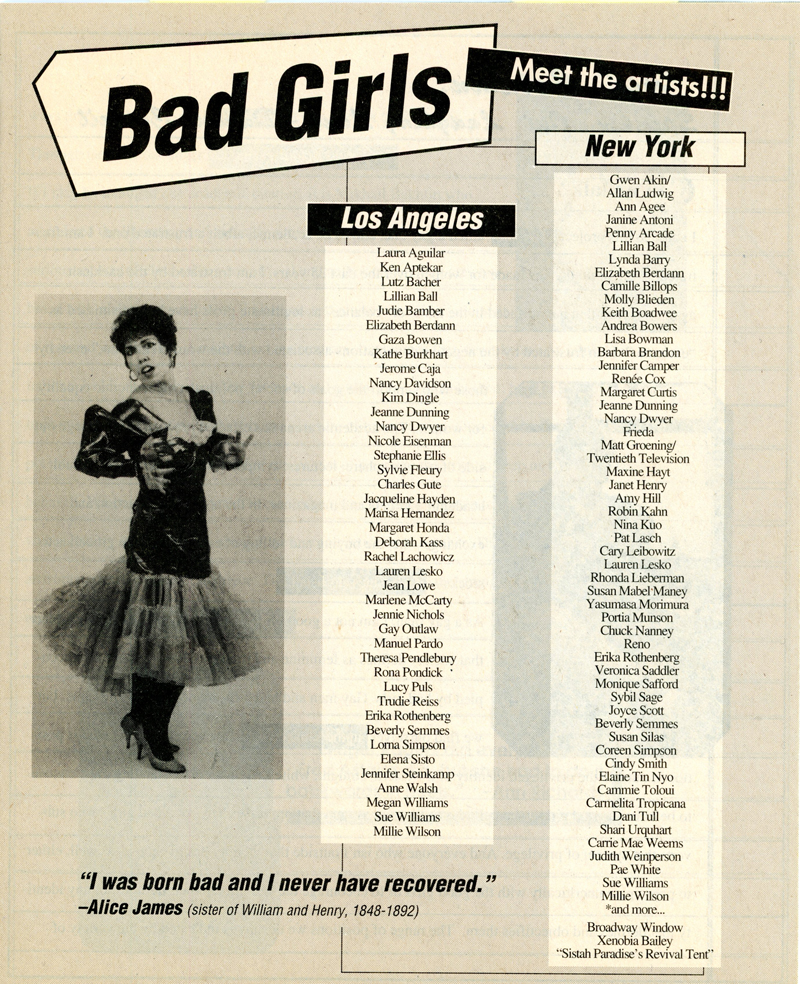
The New Museum, Wight Art Gallery (Los Angeles, Bad Girls, Bad Girls West, Cover Art by Nancy Dwyer, Marcia Tucker, Marcia Tanner, 20 Page Brochure, 1994. Gallery 98, gallery98.org/2021/the-new-museum-wight-art-gallery-los-angeles-bad-girls-bad-girls-west-marcia-tucker-marcia-tanner-20-page-brochure-1994/.
In her show, Tucker wanted to convey the image of “bad girls” as women who challenged traditional notions of femininity, choosing instead to define themselves on their own terms—embracing their own pleasures, interests, and unique approaches. By redefining “bad girl,” a linguistic reclamation takes place, and a negative term is transformed into an empowered one. By grounding the term in both feminist and AAVE contexts, she broadens its inclusivity and creates a layered narrative for the show. This act of reclamation directly challenges historical and cultural stereotypes, positioning the exhibition itself as an argument for self-representation and intersectional feminism (Tucker, Bad Girls 4).
The paragraphs that follow explain her decision to put men in the show. Firstly, it was never Tucker’s intention to reinforce “women’s art” as its own category, further forcing women into a box. She agreed to the addition of men because she saw them as willing soldiers in the fight against misogyny and didn’t find it productive to turn them away. She labels them “good boys” as opposed to “bad girls” (Tucker, Bad Girls 5). Including men in Bad Girls subverted expectations of a feminist show. It positioned men as allies rather than adversaries in the feminist movement and counteracted the narrative that feminism is exclusively for women. Tucker’s labeling of men as “good boys” creates a playful yet serious counterpoint to “bad girls,” emphasizing the need for collaborative efforts to dismantle misogyny.
Marcia Tucker’s career exemplifies how rhetoric can manifest through curatorial practice, serving as a powerful tool for advocating systemic change and connecting diverse audiences to marginalized art forms. Through exhibitions like Bad Girls and her revolutionary presentation of Lee Krasner’s work, Tucker challenged institutional norms and expanded the parameters of inclusion in the art world. Her ability to frame and present these narratives, combined with her use of humor, bold curatorial decisions, and refusal to conform to traditional museum structures, left an indelible mark on modern museum practices. Tucker’s legacy lies not only in the groundbreaking exhibitions she curated but also in the way she shaped her professional identity, reimagined the role of museums, and exemplified the potential of curatorial rhetoric. By foregrounding marginalized voices and rethinking what a museum could be, she paved the way for future generations to continue challenging and reshaping the art world. Her career serves as both an inspiration and a call to action, urging us all to critically examine whose voices are being heard and whose stories remain untold.
Cohen, Alina. “Lee Krasner Gets Her Due as a Pioneer of Abstract Expressionism | Artsy.” Artsy, 2019, http://www.artsy.net/article/artsy-editorial-lee-krasner-finally-appreciated-mrs-pollock.
Tucker, Marcia and Paul Cummings. “Oral History Interview with Marcia Tucker.” https://www.aaa.si.edu/collections/interviews/oral-history-interview-marcia-tucker-12818 Accessed 2024.
Dawson, Kathryn. “Playing the Game: Understanding the Gender Gap in Art Museum Directorships.” The Museum Scholar, 20 Apr. 2021, articles.themuseumscholar.org/2018/05/19/vol2no1dawson/.
Association of Art Museum Directors (AAMD). “Latest Art Museum Staff Demographic Survey Shows Number of African American Curators and Women in Leadership Roles Increased.” Association of Art Museum Directors, 2019, aamd.org/for-the-media/press-release/latest-art-museum-staff-demographic-survey-shows-number-of-african.
Smith, Roberta. “Marcia Tucker, 66, Founder of a Radical Art Museum, Dies.” The New York Times, The New York Times, 19 Oct. 2006, www.nytimes.com/2006/10/19/obituaries/19tucker.html.
Tucker, Marcia, and Liza Lou. A Short Life of Trouble: Forty Years in the New York Art World. University of California Press, 2010.
Tucker, Marcia. Bad Girls. New Museum of Contemporary Art; MIT Press, 1994.
Tucker, Marcia. Out of Bounds: The Collected Writings of Marcia Tucker. Edited by Lisa Phillips et al., The Getty Research Institute and the New Museum, 2019.
 Soleil Parks
Leave a comment